
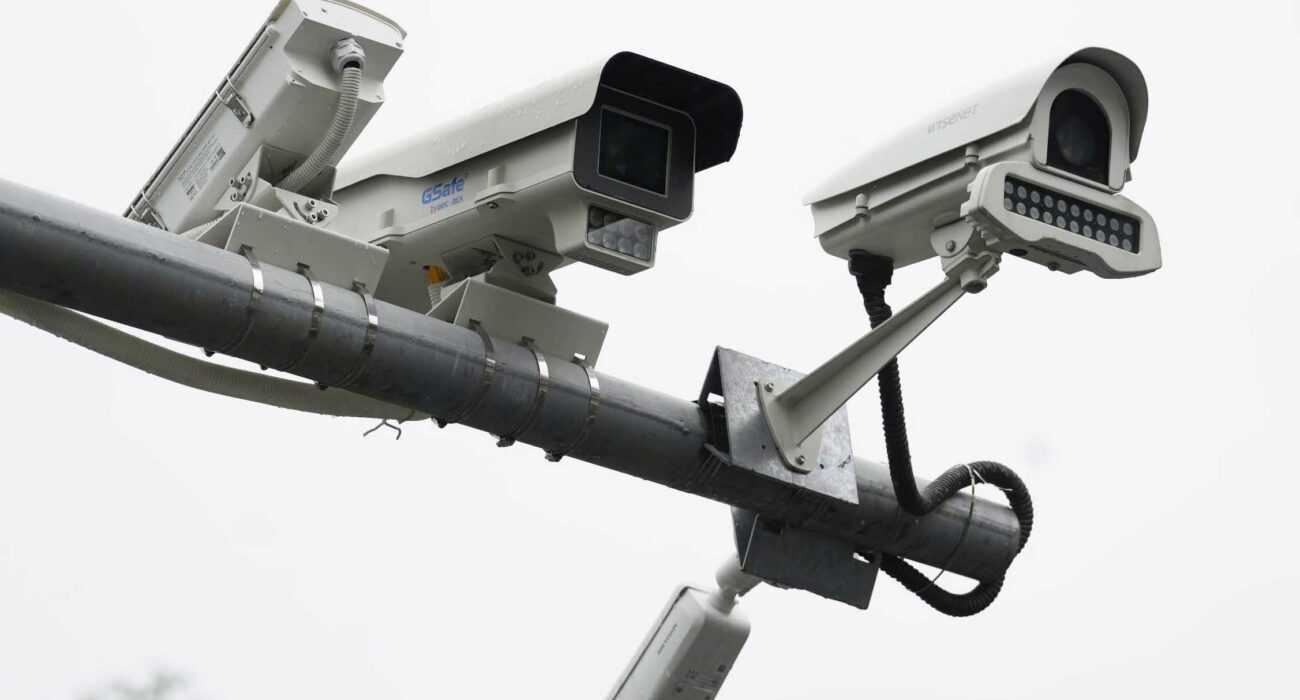
In recent years, many local authorities have accelerated the use of surveillance cameras and AI cameras in public security management. In Hanoi, the city police announced an AI camera system to support the monitoring of public security, traffic order, urban order, and public spaces. At the local level, Thanh Liet Ward has introduced an AI camera model as an “extended arm” for maintaining public order and security. Meanwhile, Thanh Hoa has also invested in 1,100 AI cameras in key wards and communes to expand monitoring capabilities and make better use of visual data for local management.
In practice, security monitoring at the ward and commune level does not only require more cameras. It requires a system that can detect incidents early, send timely alerts, and store data for later search and verification. This is where AI security cameras for wards and communes play an important role, helping local authorities monitor their areas more proactively and effectively.
What Is an AI Security Camera?
An AI security camera is a camera system integrated with artificial intelligence to automatically analyze images, detect abnormal events, and send alerts to the responsible personnel.
Unlike traditional cameras that mainly record footage for later review, AI cameras can support the detection of strangers, vehicle recognition, intrusion alerts, crowd gathering detection, and altercation detection within monitored areas.
For wards, communes, government offices, schools, hospitals, and critical areas, AI cameras help shift security monitoring from a passive approach to a more proactive one. Instead of continuously watching multiple screens, responsible teams can focus on handling incidents when the system detects events that require attention.
Current Challenges and the Need for AI Security Cameras in Wards and Communes
Many localities already have surveillance cameras installed at administrative offices, school gates, markets, parks, streets, parking areas, or residential zones. However, if cameras only record footage, their practical value remains limited.
When an incident occurs, officers often need to manually review video footage by time frame and camera location. This process takes time, may miss important details, and is not suitable for situations that require a fast response.
AI cameras help address three key needs:
- Detect incidents earlier
- Send alerts to the right personnel
- Store data for quick search when needed
For example, when someone enters a restricted area after working hours, the system can detect the event and send an alert. When a suspicious vehicle appears in a monitored area, the system can record the license plate, time, and location. When a crowd forms unexpectedly, the responsible officer can receive an alert and check the situation in time.
How Do AI Security Cameras Work?
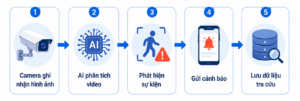
Operators can configure the system based on specific security scenarios. For example, they can define which areas require intrusion alerts, which time periods need stricter monitoring, which vehicles are allowed to enter or exit, and which faces belong to watchlist groups.
When an event matches the configured scenario, the system sends an alert to a central monitoring screen, management software, mobile application, or other notification channels depending on the deployment model.
Key Features of AI Security Cameras
Facial Recognition in Critical Areas
The system automatically compares captured facial images with pre-configured databases to support early detection of potential security risks at administrative offices or public areas.
This database may include internal personnel, registered visitors, authorized users, or watchlist individuals. When a match is detected, the system records the event, stores the related image, and sends an alert to the responsible person.
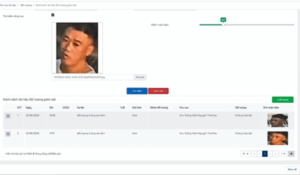
This feature is suitable for ward and commune offices, public service areas, government office entrances, schools, hospitals, public events, or areas that require access control.
The main benefit of facial recognition is faster identification and easier retrieval of appearance history when verification is needed. The system does not replace public security forces. Instead, it provides additional data to support faster checking and response.
License Plate Recognition for Vehicle Control
License plate recognition, also known as ANPR, enables the system to automatically record vehicles passing through monitored areas. Stored data may include the license plate number, vehicle image, time, and camera location.
When verification is needed, officers can search by license plate number, time range, or monitoring area. This significantly reduces the time required to trace vehicles compared with manually reviewing video footage.
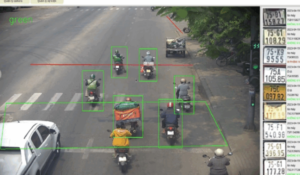
For access control scenarios, license plate recognition can be combined with a list of registered vehicles. The system can support the detection of unregistered vehicles, vehicles entering or exiting outside permitted hours, or vehicles that require attention.
Crowd Detection and Disturbance Detection
In public areas, early detection of crowds or altercations is important. These situations can develop quickly. If authorities only rely on public reports or post-event video review, response may be delayed.
AI cameras can analyze images to detect unusual increases in people density, crowd formation in sensitive areas, or signs of altercation. The system can also support the comparison of visual data with pre-configured security lists to help detect early risks to public order at administrative offices or public spaces.
When an alert is generated, the responsible person can check the live camera feed and coordinate response forces if needed.
Intrusion Alerts Using Virtual Fences
Intrusion detection allows operators to set up virtual monitoring zones in areas that need protection. When a person or vehicle enters a defined zone, the system automatically detects the event and sends an alert.
This feature is especially suitable for government offices after working hours, storage areas, parking lots, power stations, server rooms, technical areas, construction sites, and public assets.
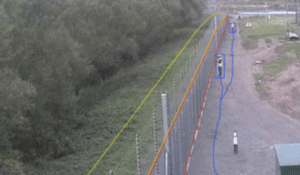
For example, a schoolyard may be open during the day but trigger alerts at night. A storage area may only allow access to authorized personnel. A construction site can generate alerts when someone enters a hazardous area outside working hours.
With virtual fences, organizations can protect critical areas more effectively without relying entirely on manual patrols.
The Value Is Not in Individual Cameras
An effective AI security camera system is not simply about installing more cameras. The greater value lies in centralized management software.
On a unified interface, operators can monitor multiple areas, configure alerts, assign user permissions, review events, and export reports. Each alert can be stored with an image, timestamp, camera location, and event type.
As a result, camera data is no longer scattered across separate devices. It is brought into one system for easier management, search, and operational use.
For wards and communes, this helps identify security hotspots more effectively. For offices, schools, hospitals, and construction sites, the system helps control people and vehicles entering and exiting more tightly.
Key Considerations When Deploying AI Security Cameras
Before implementation, the first step is to clearly define the problem that needs to be solved. Instead of starting with the question “How many cameras should be installed?”, local authorities should begin with their management needs.
Key questions include:
- Which areas need to be monitored?
- Does the system need to recognize people, vehicles, or behaviors?
- Which time periods have higher security risks?
- Who should receive alerts?
- How should data be stored and searched?
Image quality is also important. Camera angle, lighting, resolution, and movement flow all affect recognition performance. If an existing camera system is already in place, it should be assessed first to determine whether it can be reused before investing in new devices.
Facial data, license plate data, and access history should also be clearly permissioned. Only authorized personnel should be allowed to view, search, or export reports. This is essential for transparent and secure system operation.
How Does ATIN Provide AI Security Camera Solutions?
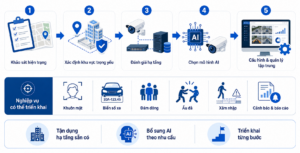
ATIN deploys AI security camera solutions based on the real operational needs of each locality or organization. The process begins with a site survey, identification of critical areas, assessment of camera, network, and server infrastructure, selection of suitable AI models, and configuration of centralized management software.
Available security functions include facial recognition, license plate recognition, crowd detection, altercation detection, intrusion alerts, event management, real-time alerts, and dashboard reporting.
Conclusion
AI security cameras help surveillance systems move from passive recording to proactive detection and alerting. With features such as facial recognition, license plate recognition, crowd detection, altercation detection, and intrusion alerts, the system supports faster incident awareness and easier data retrieval.
For wards, communes, and critical areas, AI cameras are not only surveillance devices. They are data-driven tools that support more effective security management.
ATIN is ready to provide consultation and demo AI security camera solutions tailored to the practical needs of each ward, commune, agency, or critical area.
>>> See more: AI Camera Surveillance Solution for Wards/Communes
AI Camera for Traffic Violation Monitoring in Wards/Communes
AI Camera for Urban Management in Wards/Communes
AI Camera for Smoke/Fire Detection