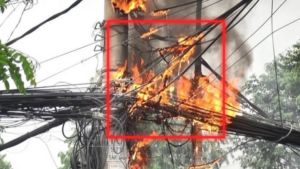
Today, fire and explosion risks in residential areas, local markets, parking lots, and public spaces are becoming harder to control if monitoring still relies mainly on manual observation. According to the Fire Prevention, Fighting and Rescue Police Department, Vietnam recorded 1,710 fires in the first six months of 2025, with electrical system and equipment failures among the main causes. Many fires caused by electrical short circuits or electric vehicle batteries show that risks often begin with small signs such as smoke, sparks, or smoldering fire.
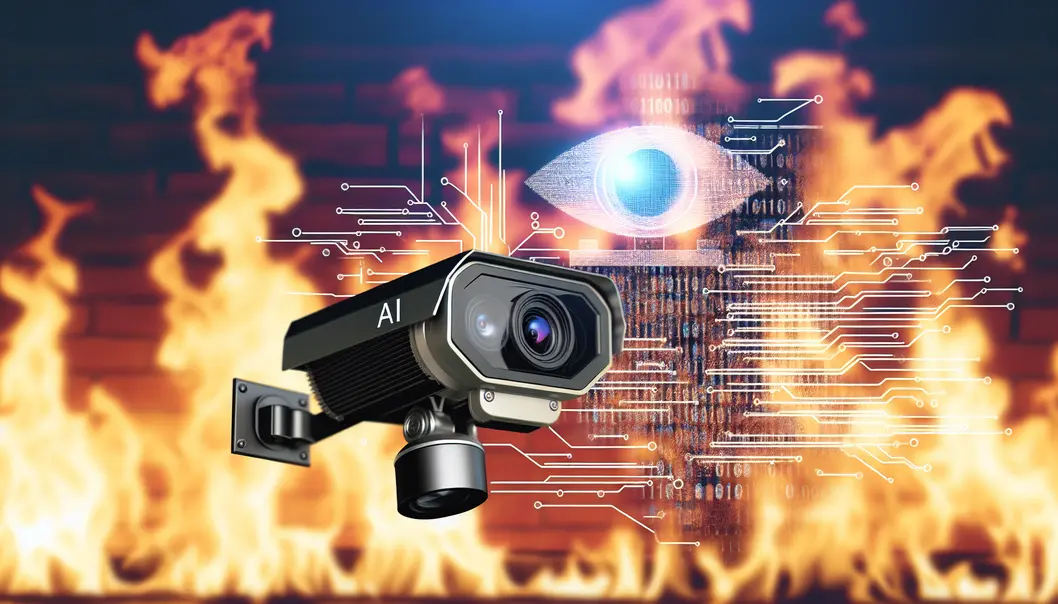
In this context, an AI camera for smoke/fire detection becomes a smart fire safety monitoring layer for wards and communes. The system helps identify early signs of smoke or fire through camera images, send instant alerts to responsible personnel, and support timely response before the incident spreads.
How is an AI camera different from a conventional surveillance camera?
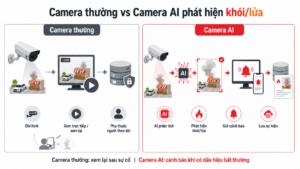
Conventional surveillance cameras mainly record, transmit, and store video footage. Users can watch live footage or review recordings after an incident occurs.
However, a standard camera cannot understand what is happening in the frame. Without someone monitoring the screen, small signs of smoke or fire may be missed.
A standard camera is mainly used for observation and post-incident review. Smoke/fire detection still depends heavily on human operators, so early warning signs can easily be overlooked.
An AI camera supports more proactive monitoring by analyzing images in real time, detecting signs of smoke/fire, sending alerts, and storing event data.
What is an AI camera for smoke/fire detection?
An AI camera for smoke/fire detection is a system that combines surveillance cameras with artificial intelligence algorithms to analyze video images in real time.
Instead of only recording footage like a conventional camera, an AI camera can detect abnormal signs within the frame, such as:
Smoke appearing in the monitored area: AI can analyze the presence, spread, or abnormal movement of smoke in the image and trigger an alert.
Flames or abnormal bright areas: The system can identify flames, bright areas that may indicate fire, or continuous visual changes over time.
Abnormal events at high-risk locations: For example, parking lots, waste collection points, technical rooms, storage areas, local markets, or public spaces with limited on-site supervision.
Why do residential areas, markets, and parking lots need AI cameras for fire safety?
Residential areas, markets, parking lots, and public spaces often have high densities of people and vehicles. Many areas contain flammable materials, electrical equipment, goods, waste, or closely parked vehicles.
If an incident occurs outside working hours, at night, or in a blind spot, it is difficult to detect it by human observation alone. This is why management units should consider deploying AI cameras for fire safety at high-risk locations.
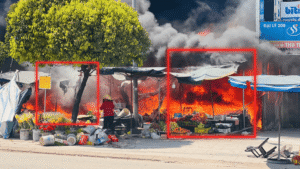
Local markets contain many fire-risk points
Markets usually have multiple kiosks, goods, electrical wiring, cooking equipment, temporary storage areas, and flammable materials. After closing hours, if smoke or smoldering fire appears, on-duty personnel may not detect it immediately.
AI cameras can support monitoring at main walkways, kiosk areas, electrical zones, storage areas, or locations with limited visibility.
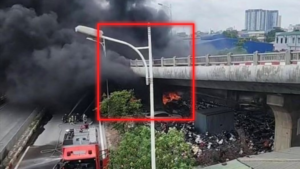
Public parking areas have a high risk of rapid fire spread
Public parking lots and vehicle storage areas often contain many vehicles parked close together. If a fire starts from one vehicle, the risk of spreading to surrounding areas is very high.
In this scenario, an AI fire detection camera helps detect smoke/fire early in blind spots, crowded vehicle areas, or locations that security staff cannot monitor continuously.
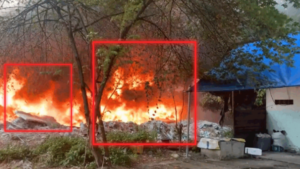
Waste collection points are prone to smoldering fires
At waste collection points, risks may come from dry waste, flammable materials, leftover embers, or scrap materials. Many incidents begin with a small amount of smoke, and if not detected early, the fire may spread quickly.
Therefore, fire safety monitoring in residential areas using AI cameras can prioritize waste collection points, temporary garbage areas, or scrap zones.
How does an AI camera for smoke/fire detection work?
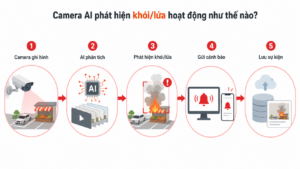
The operating process of an AI camera for smoke/fire detection is straightforward: the camera captures images in the monitored area, AI analyzes the video in real time, detects abnormal signs, and sends instant alerts to responsible personnel. The entire event is also stored for review, inspection, and reporting when needed.
Step 1: Camera captures images
The camera is installed in areas that need monitoring, such as markets, parking lots, storage areas, waste collection points, technical rooms, community houses, or public spaces.
Camera footage is transmitted to the AI processing system.
Step 2: AI analyzes video in real time
AI continuously analyzes images within the frame. The system checks for abnormal signs related to smoke, fire, or suspicious bright areas.
Unlike analyzing a single image, AI evaluates visual changes over time to assess the likelihood of an event.
Step 3: The system generates an alert
When signs of smoke/fire exceed the configured threshold, the system generates an alert.
Alerts can be classified by area, camera, time, and priority level.
Step 4: Notification is sent to responsible personnel
Alerts are displayed in real time on the central monitoring screen, management software, mobile application, or device of the responsible person immediately after the system detects signs of smoke/fire.
Depending on the deployment plan, alerts can also be connected to other notification channels so responsible personnel can receive updates instantly, verify the situation quickly, and respond before the incident spreads.
Step 5: Event data is stored
Each alert is stored with images, video, time, camera location, and handling status.
This data helps management units review events, assess causes, and prepare reports when needed.
Benefits of AI cameras for smoke/fire detection for management units
Proactively identify risks at an early stage
The greatest value of an AI camera for smoke and fire detection is reducing detection time. When smoke or fire first appears within the camera’s field of view, the system can record the event and send an instant alert.
The earlier an incident is detected, the better the chance of checking and handling it at the initial stage.
Reduce reliance on manual monitoring
With traditional manual monitoring, operators cannot continuously watch multiple camera screens for long periods. Small abnormal signs such as newly appearing smoke, early flames, or smoldering fire may be missed if they do not occur at the exact moment of observation.
AI helps filter abnormal events and send real-time alerts to responsible personnel. As a result, the operations team can focus on important alerts instead of continuously watching all camera feeds.
Store transparent event data
Each event includes images, video, time, camera location, and handling status.
This data supports review, reporting, cause analysis, and improvement of safety monitoring procedures.
Support local safety management
For wards/communes, market management boards, parking operators, or residential areas, AI cameras are a practical tool to strengthen monitoring capacity.
The system not only records footage but also supports early alerts, helping responsible teams respond faster.
>>> See more: AI Camera Surveillance Solution for Wards/Communes
Can AI cameras replace fire alarm systems?
AI cameras for smoke/fire detection do not replace fire alarm systems, firefighting equipment, fire response plans, or fire safety procedures required by regulations.
AI cameras only support early detection through visual analysis. The system helps identify signs of smoke/fire within the camera’s field of view and sends alerts for human verification.
Requirements related to fire alarm systems, firefighting equipment, emergency exits, fire response plans, and operating procedures must still fully comply with current regulations.
In other words, the regulated fire safety system is the mandatory layer. AI cameras are an additional layer that enhances visual monitoring and early warning capability.
Conditions for AI cameras to detect smoke/fire effectively
For AI cameras for smoke/fire detection to operate effectively, the system must be properly surveyed and configured from the beginning. Cameras need a clear view of the monitored area, with limited blind spots, obstructions, or incorrect installation angles.
Image quality is also important. Areas that are too dark, strongly backlit, dusty, humid, or affected by reflected light may reduce the AI’s ability to detect smoke/fire.
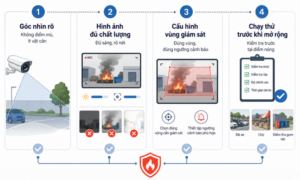
In addition, the system must be configured with the right monitoring zones, alert thresholds, and priority levels for each area. For high-risk locations such as parking lots, markets, or waste collection points, pilot testing should be conducted before wider deployment to evaluate camera suitability, alert accuracy, and the alert response process.
AI Camera Deployment Model for Fire Safety Monitoring in Wards/Communes
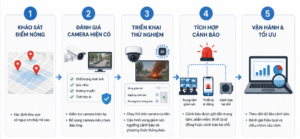
Phase 1: Survey high-risk locations
Identify areas with high fire and explosion risks, such as markets, parking lots, waste collection points, storage areas, community houses, technical rooms, or crowded public spaces.
Phase 2: Evaluate existing cameras
Check whether current cameras have sufficient image quality, viewing angle, network connection, and AI integration capability.
If existing cameras do not meet the requirements, additional cameras should be installed in suitable positions.
Phase 3: Pilot deployment
Run a pilot on selected priority cameras. During this phase, the system is configured with monitoring zones, alert thresholds, and notification methods.
Phase 4: Integrate alerts
Alerts can be sent to the monitoring center, management software, mobile devices, or on-site alert systems, depending on the deployment plan.
Phase 5: Operate and optimize
After deployment, the management unit should monitor alert data, evaluate system performance, and adjust configurations when necessary.
You need detailed consultation on deploying an AI camera system for fire safety monitoring in wards/communes?
Conclusion
An AI camera for smoke and fire detection is an important supporting solution for safety monitoring in residential areas, markets, parking lots, and public spaces. The system helps detect early signs of smoke/fire through video images, send fast alerts, store event data, and support responsible teams in timely verification.
However, AI cameras must be understood in the right role. They are a supporting tool for fire safety monitoring and do not replace fire alarm systems or fire prevention and fighting requirements under regulations.
For local authorities, management boards, and operating units that need to strengthen safety monitoring capacity, deploying AI cameras for fire safety at high-risk locations is a practical, scalable, and suitable approach for today’s management needs.
>>> See more: AI Camera Surveillance Solution for Wards/Communes
AI Camera for Traffic Violation Monitoring in Wards/Communes