
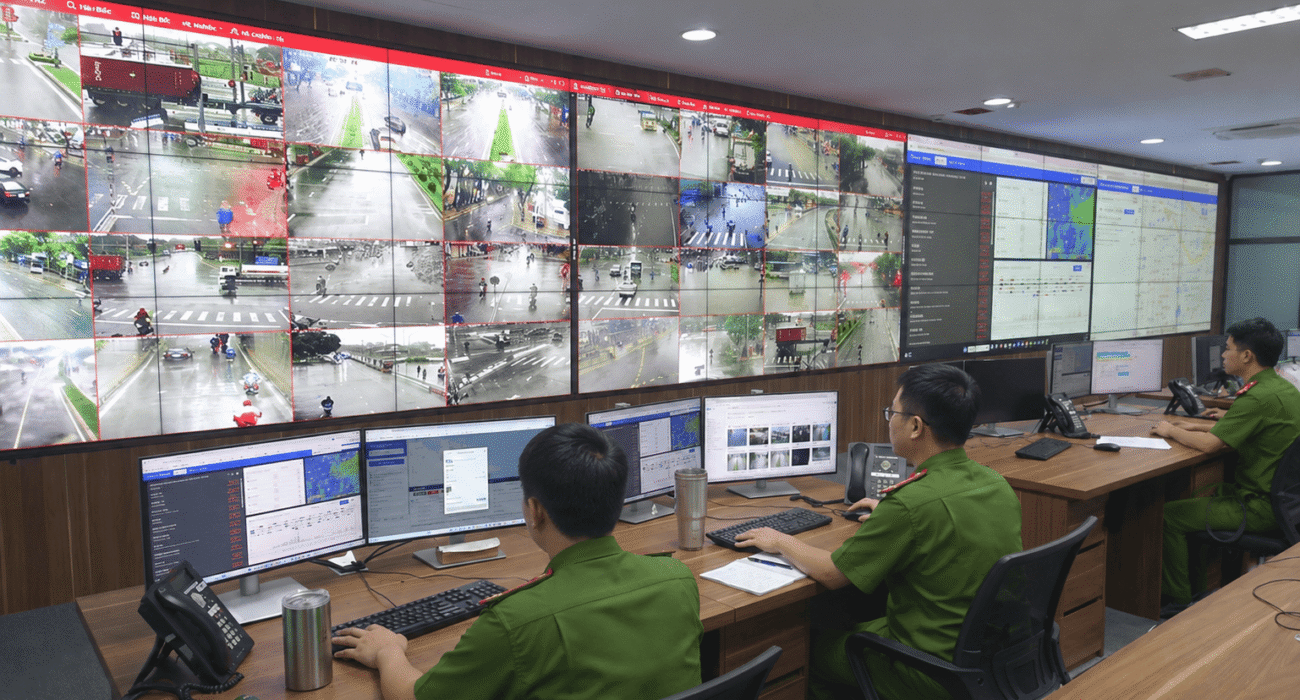
In many wards and communes, surveillance cameras have already been installed across roads, residential areas, school gates, markets, and public security hotspots. However, camera data is often fragmented across separate recorders, locations, and systems, while monitoring still depends heavily on manual observation.
To move beyond passive video recording, local authorities need a centralized operations platform that can receive camera data, detect events, and support incident handling through a clearer workflow. This is the foundation that helps wards and communes shift from fragmented camera monitoring to data-driven local operations.
What Is an Intelligent Operations Center?
IOC stands for Intelligent Operations Center. At the ward and commune level, an IOC can be understood as a centralized platform that brings together data from cameras, digital maps, alert systems, and operational applications into a single monitoring and management interface.
When integrated with AI cameras, an IOC enables local officers to monitor public areas in real time, receive alerts, identify event locations, assign incidents to the relevant teams, and retrieve data when verification is required.
How an IOC Helps Wards and Communes Operate Camera Systems with Data
As the number of cameras increases across a local area, the challenge is no longer simply about watching more locations. The real challenge is how to manage camera data centrally, detect the right events, and coordinate timely responses with the appropriate departments.
With traditional camera operation, officers often have to monitor multiple screens or review footage only after a complaint is reported. This approach can lead to missed incidents, time-consuming searches, and limited data for reporting or operational review.
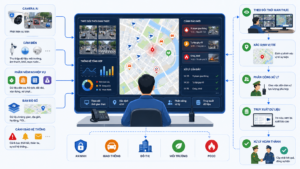
An AI Camera-integrated IOC brings camera feeds, AI-generated metadata, and operational data into one centralized interface. From this interface, officers can monitor alerts, view event locations, retrieve relevant data, and understand the overall situation in real time.
In other words, AI cameras help detect events, while the IOC helps manage, coordinate, and process those events based on centralized data.
Key Features of an IOC Integrated with AI Cameras
GIS Digital Map: Visualizing Events by Location
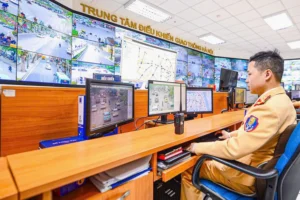
A GIS digital map displays camera locations, monitored areas, and alert points directly on the local map. This allows officers to quickly understand where an event is happening, what type of alert it is, and how it should be prioritized.
For ward and commune-level deployment, GIS does not need to be overly complex at the initial stage. The key requirement is that cameras and alerts are accurately linked to their actual locations, enabling more intuitive operations instead of manually searching across multiple screens.
Real-Time Alerts: Faster Detection and More Targeted Response
When AI cameras detect an abnormal event, the IOC receives and displays the alert in real time. Each alert may include the time, location, camera ID, related images or video, event type, and processing status.
Alerts can be categorized by operational groups such as public security, traffic, urban order, environmental management, or fire prevention. As a result, each event can be routed to the right responsible team, helping reduce the time from detection to response.
Smart Search: Faster Retrieval for Verification
Once an event is recorded, the IOC stores key information such as time, location, camera, alert type, images or video, and processing status. When officers need to verify an incident or prepare a report, they can search by time, location, camera, event type, or handling status.
This feature helps reduce the time spent manually reviewing footage. It also supports wards and communes in tracking hotspot areas, reviewing incident history, and providing evidence for reports or follow-up actions.
What Operations Can an IOC Support at Ward and Commune Level?
An IOC acts as a shared operations layer for multiple local management tasks. Alerts from AI cameras are centralized into one interface and linked with time, location, camera information, and handling status, making it easier for officers to monitor, classify, and coordinate responses.
Public Security and Order
The system can receive alerts related to unusual gatherings, intrusion into restricted areas, fights, or persons of interest. Events are displayed by location, helping the responsible teams quickly understand the situation and respond in a timely manner.
Urban Order Management
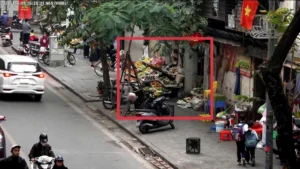
An IOC can support the monitoring of common issues on roadsides, sidewalks, markets, school gates, and crowded streets, such as sidewalk encroachment, unauthorized street vending, and prolonged parking at hotspot areas.
Traffic Monitoring
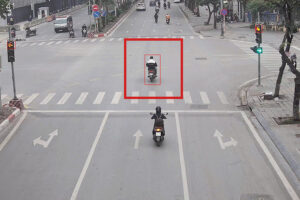
Alerts related to illegal parking, abnormal congestion, traffic violations, or license plate recognition can be displayed directly on the system. This helps officers identify the location, time, and priority level of each case more efficiently.
Environmental Management
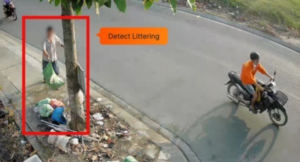
The system can record violations such as illegal dumping, improper waste collection, or repeated incidents at environmental hotspots. The data can be stored for tracking frequency, location patterns, and follow-up actions such as reminders or enforcement.
Fire Prevention and Safety Monitoring
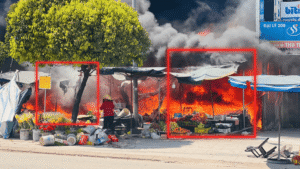
The IOC can receive smoke or fire alerts from AI cameras and display the event location along with the related camera information. This supports faster response in high-risk areas such as markets, densely populated residential zones, parking areas, or goods storage points.
How Is an IOC Different from VMS or a Conventional Camera System?
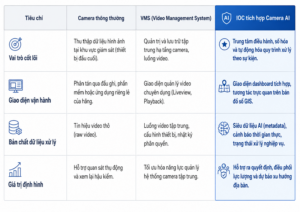
A conventional camera mainly functions as an endpoint device that captures images at the monitored location. To access the footage, operators often need to use separate DVR/NVR systems or vendor-specific applications.
A VMS, or Video Management System, is a centralized video management platform that helps manage video streams, storage, user permissions, and basic alerts such as motion detection.
An IOC operates at a higher operations layer. It does not replace the VMS. Instead, it works as a central platform that receives data from the VMS, metadata from AI cameras, GIS information, and other operational systems. This allows the IOC to digitize the overall status of the local area and support a more structured incident response workflow.
Key Conditions for Effective IOC Deployment
To ensure effective operation, wards and communes should first identify their priority operational use cases. Each locality may have different priorities, such as public security, traffic, urban order, environmental management, or fire prevention.
In addition, it is necessary to review the existing camera infrastructure, installation locations, image quality, network connectivity, and processing devices. Cameras and alerts should also be accurately mapped to the GIS interface to support intuitive operations.
The system should include user permissions, activity logs, alert handling workflows, and clear data security policies, especially for data related to images, license plates, or faces.

How ATIN Deploys AI Camera-Integrated IOC Solutions for Wards and Communes
ATIN deploys AI Camera-integrated IOC solutions with a flexible approach based on the existing infrastructure and actual management needs of each locality. The deployment process starts with a survey of the current camera system, network infrastructure, processing devices, key monitoring areas, and priority operational requirements.
Based on the survey results, ATIN works with local authorities to define suitable operational groups such as public security, traffic, urban order, environmental management, or fire prevention. AI scenarios are then configured according to specific objectives and integrated into the IOC interface with functions such as GIS digital maps, real-time alerts, event search, statistical dashboards, user permissions, and operational reports.
For localities that already have an existing camera system, ATIN can assess whether the current infrastructure can be reused and upgraded with AI and IOC capabilities. This helps optimize the initial investment cost. Wards and communes can also start with pilot deployment at selected key locations, evaluate operational effectiveness, and then expand gradually across the entire area.
Conclusion
An AI Camera-integrated IOC helps wards and communes move from fragmented camera monitoring to centralized, data-driven operations. Through GIS digital maps, real-time alerts, and smart event search, the system supports faster detection, more targeted response, and easier data retrieval when verification is required.
With the right deployment approach, an IOC does more than support camera monitoring. It becomes a centralized platform that helps local authorities manage their areas more proactively, visually, and transparently with data.
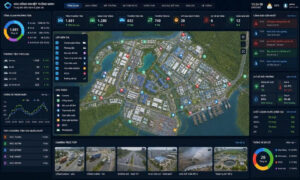
ATIN provides AI Camera-integrated IOC solutions tailored to the actual operational needs of each locality, from infrastructure assessment and AI scenario configuration to GIS mapping, alert setup, data retrieval, and reporting on a centralized operations platform.
See more:
AI Camera Surveillance Solution for Wards/Communes
AI Camera for Traffic Violation Monitoring in Wards/Communes