
Many wards and communes have already installed cameras at administrative offices, roads, residential areas, markets, schools, and public locations. However, most existing systems still mainly serve the purpose of recording and storing video footage. When a complaint is reported or an incident occurs, officers often have to manually review video clips, identify the correct time frame, select the right camera, and locate the exact area where the incident took place.
This process is time-consuming and may easily miss important details, especially in areas with multiple cameras, several security hotspots, or incidents occurring at night or during peak hours.
Therefore, the key challenge is no longer simply installing more cameras. The real question is how wards and communes can manage, utilize, and extract value from camera data more effectively.
AI Camera Is Moving Beyond the Experimental Stage
AI Camera has entered the practical application stage in many localities, especially in traffic monitoring, public security, and urban order management.
In Hanoi, AI-integrated camera systems have been put into operation to monitor and handle traffic violations. During the four-day holiday period from April 30 to May 3, 2026, the system recorded 986 cases of traffic order and safety violations. Previously, the city had also operated 1,837 AI cameras to support monitoring, detection, and violation handling.
Beyond Hanoi, Ho Chi Minh City is also expanding the use of AI cameras in urban traffic management. According to VNA/VietnamPlus, the system detected more than 19,300 traffic violations after three months of operation. In Quang Ninh, nearly 300 AI cameras have also been installed to monitor and handle traffic violations.
Why Should Wards and Communes Go Beyond Installing More Cameras?
In local area management, fragmented camera systems create many limitations in data utilization. Even when cameras are installed in multiple locations, wards and communes may still face familiar challenges: difficulty identifying which cameras are offline, difficulty retrieving footage at the right time, difficulty consolidating data for briefings, and difficulty monitoring multiple areas at the same time.
Having cameras is only the first step. To make cameras truly support daily management, wards and communes need a system that can connect, analyze, and centrally manage visual data.
| Traditional Surveillance Cameras | Centralized AI Camera System |
| Mainly record and store video footage | Automatically detects abnormal events |
| Footage is reviewed only when an incident occurs | Alerts are sent in real time |
| Officers must manually search through each camera | Data can be searched by time, area, and event type |
| Data is scattered and difficult to consolidate | Officers have additional evidence for handling and reporting |
How AI Camera Supports Security Management for Wards and Communes
AI Camera does not replace local officers. Instead, it helps detect events faster, makes data retrieval easier, and provides additional evidence for handling incidents. When connected to a centralized monitoring system, camera data is no longer just stored video footage. It becomes manageable events that can be organized by time, location, and alert type.
Monitoring Public Security in Public Areas
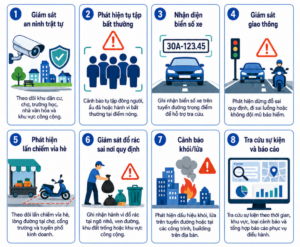
AI Camera can support monitoring in residential areas, markets, schools, cultural houses, parks, and crowded streets. The system helps detect abnormal signs and enables officers to understand the situation more quickly, instead of relying entirely on manual observation.
Detecting Crowds, Fights, or Abnormal Behavior
At public security hotspots, AI Camera can send alerts when crowds gather, abnormal movements occur, or behaviors show potential risks of disorder. Early alerts help wards and communes quickly check, verify, and coordinate responses before incidents become more serious.
License Plate Recognition on Key Roads
License plate recognition is suitable for deployment on roads, intersections, or areas where vehicle-related incidents frequently occur. The system records license plates, timestamps, and locations, helping officers quickly search and verify information when investigating collisions, public complaints, or suspicious vehicles.
Traffic and Urban Order Monitoring
AI Camera can help detect illegal parking, wrong-lane driving, failure to wear helmets, or vehicles entering restricted areas. The recorded data enables wards and communes to identify traffic hotspots, peak violation periods, and coordinate more effective handling measures.
Detecting Sidewalk and Roadway Encroachment
In market areas, school gates, commercial streets, or locations that often receive public complaints, AI Camera can monitor sidewalk and roadway encroachment. The system records incidents by area and time, providing additional evidence for reminders, inspections, or administrative handling.
Monitoring Illegal Waste Disposal
AI Camera can help detect illegal waste dumping at hotspots such as small alleys, roadside areas, vacant lots, or public spaces. Visual data helps wards and communes identify the time and location of violations, providing a basis for handling cases or adjusting environmental sanitation management plans.
Smoke and Fire Alerts on Roads and at Facilities
AI Camera can detect signs of smoke or fire on roads, in residential areas, markets, waste collection points, high-rise buildings, or other facilities within the locality. When an alert is triggered, duty officers can quickly check the images and coordinate with relevant forces for timely response.
Event Search and Reporting for Local Management
Each event is recorded with time, location, alert type, and handling status. As a result, wards and communes can quickly search for information when verifying incidents, while also consolidating data for briefings, hotspot evaluation, and data-driven local management.
AI Camera helps wards and communes shift from “reviewing footage when needed” to “detecting, alerting, searching, and managing with data.”
AI Camera System Model for Wards and Communes
A suitable AI Camera system for wards and communes does not only include cameras installed on-site. It also requires centralized management software to connect, monitor, and utilize data from multiple areas.
In general, the model can be understood through four layers:
On-site Cameras → AI Box or AI Server → Centralized VMS Monitoring Software → Dashboard, Alerts, and Reports
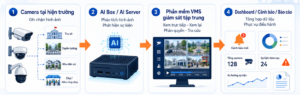
Cameras capture images in key areas. AI analyzes video and detects events. The VMS allows officers to view live footage, review recordings, manage user permissions, and search data. The dashboard consolidates alerts, events, and reports to support local area management.
As a result, wards and communes can monitor multiple cameras on a single interface, check device status, and retrieve data more quickly for security control.
What Should Wards and Communes Consider Before Implementation?
AI Camera is not automatically effective simply because it is installed. For the system to operate well, wards and communes need to clearly define the problem from the beginning.
Key questions include:
- What issue does the area need to control first?
- Which locations are critical monitoring points?
- Which events require immediate alerts?
- Who will receive the alerts?
- What is the response process after an alert is triggered?
- Can the existing camera system be utilized?
- How will image data, license plates, and event history be permissioned?
Without clear answers, the system may easily fall into the situation of having cameras but not being able to utilize them effectively. Therefore, implementing AI Camera for wards and communes should be viewed as a comprehensive project involving infrastructure, software, data, processes, and the people who operate the system.
A Suitable Implementation Roadmap for Wards and Communes
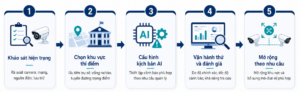
Wards and communes should implement AI Camera in phases, starting with a current-state survey and selecting several pilot areas with clear needs, such as the People’s Committee office, entry and exit points, key roads, or public security hotspots.
After the pilot phase, the system should be configured with suitable AI scenarios, tested in operation, and evaluated based on criteria such as accuracy, alert speed, search capability, and compatibility with actual handling procedures.
Once the model proves effective, wards and communes can expand to other areas and add more AI modules based on local security management needs.
ATIN Accompanies Wards and Communes in AI Camera Deployment
ATIN does not implement AI Camera as a mass installation project. Instead, ATIN starts from the actual management requirements of each ward or commune: which areas need monitoring, which events require alerts, and what data is needed to support local operations.
One practical reference is the AI Camera project deployed by ATIN for Lao Cai Provincial Police. In this project, the system was applied to monitor people of interest and vehicles, recognize license plates, identify faces, support rapid tracing, and consolidate data on a visual dashboard. This helped reduce reliance on manual monitoring and improve the effectiveness of local security management.
Conclusion
AI Camera for wards and communes is not simply about installing more smart cameras. It is about turning visual data into a tool that supports local area management.
When implemented for the right problem, in the right key locations, and connected with real handling procedures, the system can help officers detect incidents earlier, receive timely alerts, search information quickly when verification is needed, and consolidate data for local management.
As a result, cameras no longer only record incidents after they happen. They become a foundation that helps wards and communes proactively manage security, order, and risks across their areas.
Are You Evaluating the Potential of AI Camera for Your Current Surveillance System?