

Many wards and communes have already deployed cameras on roads, in residential areas, public spaces, school gates, markets, and security hotspots. However, as the number of cameras increases, the key question is no longer simply how many cameras are installed, but how the data generated by the system is managed, stored, searched, and secured.
With AI cameras, data should not remain limited to recorded video for later review. The system needs to transform visual data into structured data that can be searched by time, location, camera, license plate, object, or event type. This provides the foundation for wards and communes to use camera data more effectively, reduce manual video review, and make system operations more transparent.
What Is AI Camera Data Governance?
AI camera data governance is the process of collecting, analyzing, storing, authorizing, and using visual data from a camera system in an organized and controlled manner.
Unlike conventional cameras, which mainly record video for playback, AI cameras can analyze video streams and extract structured information such as license plate numbers, vehicle color, vehicle type, time of appearance, camera location, or event type. As a result, data is not only stored as raw video, but also organized into searchable and verifiable records.
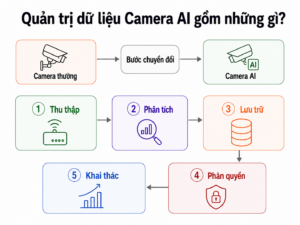
The core value of AI camera data governance lies in helping the system move from “recording video for review” to “creating logically structured data for search and management.” This is a key transformation that determines how effectively the system can support real-world operations.
AI Camera Data Flow at Ward/Commune Level
In a centralized deployment model suitable for wards and communes, cameras are installed at field monitoring locations and transmit video streams to the central system through the internal network. At the center, the system receives data, processes it with AI, stores it, and provides an interface for monitoring and data lookup.
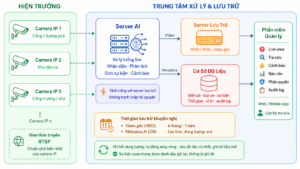
In this model, AI processes the live stream directly as it is transmitted to the center, rather than waiting for the video to be stored before analysis. This enables the system to generate alerts almost immediately when an event is detected.
In terms of hardware architecture, the AI server and storage server are separated. The AI server is equipped with GPU resources to process images and run recognition models, while the storage server uses high-capacity HDD/NAS storage to continuously store original video from all cameras. This separation helps prevent resource competition between AI processing and video storage, ensuring stable performance for both analysis and storage operations.
What Types of Data Does an AI Camera System Store?
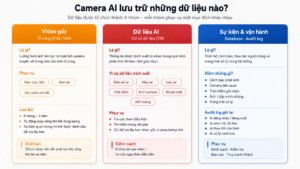
AI camera data storage is not simply about saving video files to hard drives. To support effective governance, data should be organized into three main groups: original video data, structured AI data, and event/operation data.
Original Video Data
Original video data refers to the video streams transmitted from cameras to the central system and stored on the storage server. This data is used for live viewing, playback, and detailed verification when needed.
However, if the system only stores original video without associated AI data, operators still need to manually review footage camera by camera and time frame by time frame. Therefore, original video should be combined with AI-generated data to support faster search and verification.
Structured AI Data
Structured AI data refers to the information extracted from video during the analysis process. Depending on the deployed use case, this may include license plate numbers, vehicle color, vehicle type, time of appearance, camera location, faces, or object-related information.
This group of data is stored in a database on the web/database server, allowing the system to search based on specific criteria instead of requiring users to manually review each video segment.
Event and Operational Data
Event and operational data includes generated alerts, event timestamps, related cameras, images or video clips used as evidence, processing status, and user activity history.
This data helps make system usage more transparent, supports inspection and reporting, and enables accountability when needed.
The Value of Organizing Data by Type
The value of AI cameras does not only come from the ability to store large amounts of video. It comes from how data is organized into clear, searchable, and verifiable records. When data is structured logically, operators can search faster, reduce manual review time, and use the system more effectively in daily operations.
AI Camera Data Storage: Store Logically, Not Just Longer
When deploying AI cameras for wards and communes, data retention time should be calculated based on the number of cameras, video resolution, storage capacity, search requirements, and operational regulations of each locality.
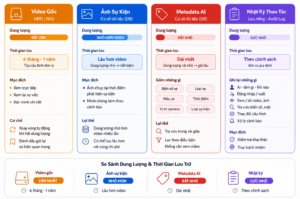
In many practical deployments, original video and AI event data are often recommended to be retained for 6 months to 1 year. This retention period is usually sufficient to support most traceability needs, from verifying incidents to assisting investigations when required. The actual retention period depends on the needs of each unit and the storage infrastructure provided.
AI camera data storage is not only about deciding how long data should be kept. It is also about organizing each type of data according to its intended purpose. This allows the system to configure suitable retention periods for original video, event images, AI metadata, and operation logs in order to optimize storage costs.
Original video is stored on the storage server’s hard drives to support detailed visual verification.
Event images are stored in the database. They require less capacity than video and can often be retained for longer periods.
AI metadata, such as license plate numbers, vehicle type, timestamps, and related attributes, is stored in the database. This data requires very little storage capacity and supports fast search.
Operation logs are stored separately to support inspection and accountability.
When storage capacity is full, the system can automatically rotate data by deleting the oldest data and writing new data, allowing continuous operation without manual intervention. For important events that need to be retained longer, such as violation evidence under review or video clips related to an ongoing investigation, the system should provide a mechanism to mark and preserve them, preventing them from being overwritten during automatic rotation.
In addition, data transmitted between cameras and servers should be encrypted using TLS/HTTPS to help prevent interception on the internal network, especially when the system is connected through shared infrastructure.
AI Camera Data Security for Wards/Communes
AI camera data may contain sensitive information such as license plate numbers, faces, images of citizens, and the time and location where vehicles or people appear in monitored areas. Therefore, data security is a mandatory requirement when deploying AI camera systems for wards and communes.
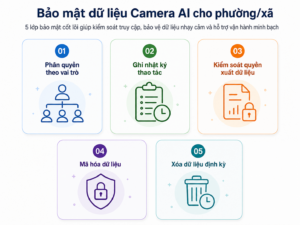
Role-Based User Access Control
Role-based access control is the most fundamental layer of data security. The system should assign permissions to different user groups based on their responsibilities and access scope.
For example, a camera viewing account should only be allowed to monitor live video and should not have permission to download data or search historical records. An alert-handling account may be allowed to review related clips and update event status. Only system administrators should be able to configure cameras, add, edit, or delete users, and modify system parameters.
This layered access model ensures that each user can only access the data and functions required for their actual role.
User Activity Logging
User activity logging, or audit logging, helps monitor the entire process of data access and usage within the system.
Important actions such as login/logout, viewing or downloading video/images, searching for license plates or faces, configuring cameras, adding/editing/deleting users, and handling alerts should all be recorded. Each log should be linked to a specific user account and timestamp to support inspection when needed.
This provides an important basis for tracing responsibility if there are concerns about unauthorized access or improper data use.
Data Export Control
For AI camera data, the permission to export images, video clips, or event reports should be strictly controlled. Each data export should be recorded with the account performing the action, the export time, and the type of data exported.
This mechanism helps reduce the risk of sensitive data being copied, shared, or used for improper purposes.
Data Encryption
The system should protect data at two levels: transmission encryption and storage encryption.
Transmission encryption helps protect data sent from cameras to servers and from servers to user interfaces, for example through TLS/HTTPS. For sensitive data stored in the database, the system should also apply storage encryption or strict access control according to the security policy of each unit.
This is an important practice for modern surveillance systems, especially when the data relates to citizens, vehicles, and appearance history in monitored areas.
Periodic Data Deletion
Periodic data deletion is not only a way to manage storage capacity, but also an important part of data security.
Sensitive data such as images of citizens, license plate numbers, or facial data should be managed according to a clearly defined retention period, rather than being stored indefinitely when there is no longer an operational need. The system should define a maximum retention period for each data group and automatically delete data after that period expires.
This helps reduce the risk of information leakage, optimize storage capacity, and support compliance with requirements related to personal data protection.
When Incidents Occur: Alerting and Data Recovery Mechanisms
A practical question often raised when deploying AI cameras for wards and communes is: what happens if the network is interrupted, cameras lose connection, or the server encounters an error?
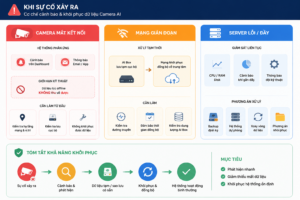
Camera Disconnection
When a camera loses connection, the system sends an alert to the operator through the dashboard and may also send notifications via email or an application, depending on the deployment configuration.
However, it is important to note that during the period when the camera is disconnected, image data at that time may not be collected by the central system if the server cannot pull the camera stream. This is a technical limitation that should be considered when designing camera locations, network infrastructure, and local storage options.
Temporary Network Interruption
When the internet connection or internal network is temporarily interrupted, the system can activate local storage at the hardware level, depending on the device configuration. This may include a dedicated memory card on the AI camera or storage on an on-site AI Box. In such cases, video streams and AI metadata such as license plates, faces, and events can continue to be recorded locally during the interruption.
Once the network connection is restored, the system can use a store-and-forward mechanism to synchronize locally stored data back to the central server. The temporary data stored at the edge is pushed back to the central system according to the configured synchronization logic, helping fill the data gap on the monitoring dashboard without requiring manual intervention from operators.
Server Error or Near-Full Storage
When the server encounters an error or storage capacity is nearly full, the system should continuously monitor operating status and generate alerts so that the technical team can respond in time.
Measures such as scheduled backup, redundancy configuration, or restore procedures should be agreed upon based on the system scale, data retention requirements, and operational needs of each locality.
Conditions for Stable System Operation
The continuity of an AI camera system depends heavily on the quality of the network infrastructure, hardware, and operational design from the beginning.
Therefore, when deploying the system, wards and communes need to clearly define the incident alerting mechanism, local temporary storage capability, backup plan, data recovery procedure, and the personnel responsible for system operation.
ATIN Consulting for AI Camera Data Governance and Storage Models for Wards/Communes
ATIN deploys AI camera systems for wards and communes based on a model that centralizes data, processes AI on real-time video streams, and organizes data according to actual operational needs. The focus is not only on installing cameras for recording, but also on building a system that can store, search, authorize, secure, and scale over the long term.
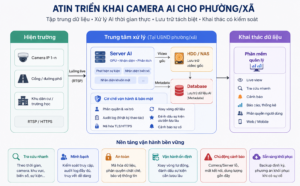
With this model, camera data is transmitted to the central system through a suitable connection protocol. AI analyzes the live stream directly to detect events, while original video and structured AI data are stored separately. This structure allows operators to quickly search data by time, camera, area, license plate, vehicle type, or event type.
In addition, the system should be designed with essential operational mechanisms such as user access control, data encryption, activity logging, automatic data rotation when storage is full, preservation of important events, alerts for camera/server issues, and backup and recovery plans.
This approach helps wards and communes manage camera systems more effectively while using AI camera data in a controlled, transparent, secure, and scalable manner.
Conclusion
For wards and communes, AI cameras are not only tools for visual monitoring. They also serve as a data platform that supports local area management. When camera data is organized in a structured way, the system can support multiple needs at the same time: storage, search, authorization, security, and control over how information is accessed and used.
Proper data governance helps operators reduce manual video review, search information faster, and better protect sensitive data such as license plate numbers, faces, citizen images, or appearance history in monitored areas. This is a key factor in ensuring that AI camera systems operate effectively, transparently, and in line with real local management requirements.
ATIN provides consulting and implementation services for AI camera solutions for wards and communes, with deployment models tailored to existing infrastructure, storage needs, security requirements, and the operational challenges of each locality.
>>>See more:
AI Camera Surveillance Solution for Wards/Communes
AI Camera for Traffic Violation Monitoring in Wards/Communes