
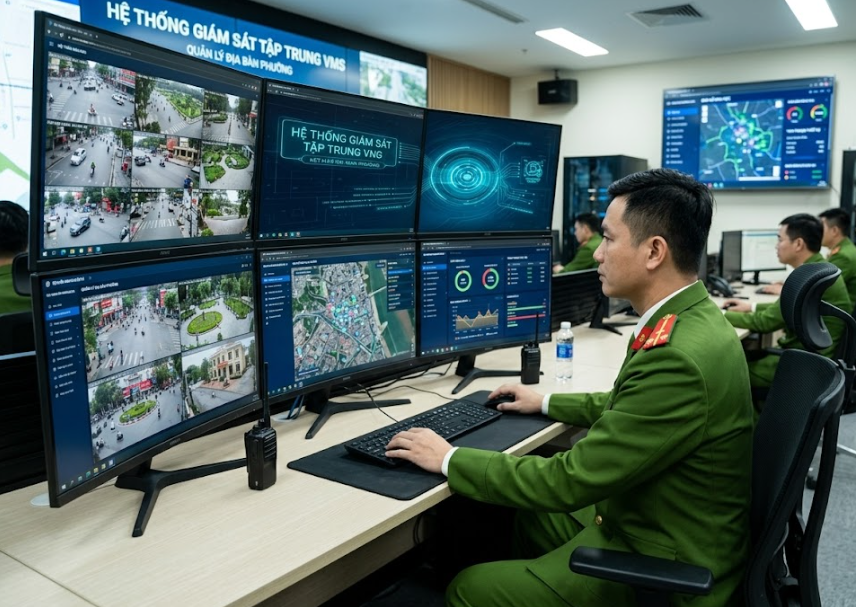
Security cameras have been installed in many wards and communes, covering school gates, markets, small streets, residential areas, government offices, and public-order hotspots. However, when video data remains scattered across multiple recorders, software platforms, and operating points, having more cameras does not necessarily mean local areas are managed more effectively.
In practice, many localities already have camera systems but still face challenges in gaining an overall view, checking device status, or retrieving video quickly when incidents occur. For wards and communes, the key challenge is not simply installing more cameras, but building a centralized VMS that can manage cameras, data, users, and alerts on a single platform.
Why Do Wards and Communes Need a Centralized VMS Integrated with AI Cameras?
For ward and commune-level authorities, the current requirement is no longer just to add more cameras, but to manage existing camera data more effectively. When video feeds are dispersed across different recorders, software systems, and operating locations, officers often spend significant time searching manually, struggle to check device status, and find it difficult to retrieve video quickly when an incident occurs.
In many localities, camera systems are becoming part of urban management infrastructure. Hanoi has put 1,837 AI cameras into operation at 195 key traffic intersections to support real-time monitoring and violation handling. Ho Chi Minh City has also deployed 31 AI cameras at major intersections, detecting more than 8,000 violations. In Quang Ninh, nearly 300 AI cameras have been installed across wards, communes, and special zones to support traffic monitoring, violation detection, and public-order management.
These examples show that AI cameras have moved beyond the pilot stage and are now being applied in real-world operations. For wards and communes, a practical approach is to standardize existing camera infrastructure, connect data to a centralized VMS platform, and then expand AI camera capabilities according to specific local needs such as illegal parking, sidewalk encroachment, improper waste disposal, abnormal crowd gathering, or intrusion into restricted areas.
At that point, cameras are no longer used only to “review footage after an incident.” They become a valuable data source that helps wards and communes monitor local areas, issue early alerts, and respond to incidents more quickly.
What Is VMS?
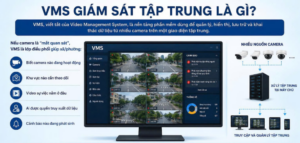
VMS stands for Video Management System. It is a software platform designed to manage, display, store, and utilize data from multiple cameras through a centralized interface. For wards and communes, a VMS serves as an operational hub that enables camera status monitoring, video retrieval, user access control, alert management, and data aggregation for reporting.
This is an important foundation for standardizing existing camera systems and expanding AI camera functions based on specific local management scenarios in later phases.
The Role of VMS in a Surveillance System
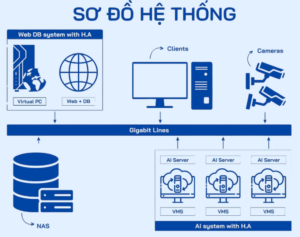
A centralized VMS connects field cameras with network infrastructure, AI servers or VMS servers, NAS storage systems, and operational interfaces. As a result, wards and communes can manage all cameras on a unified platform, monitor device status, view live footage, review recorded video, assign user permissions, and expand AI camera modules when needed.
Benefits of a Centralized VMS Integrated with AI Cameras for Wards and Communes
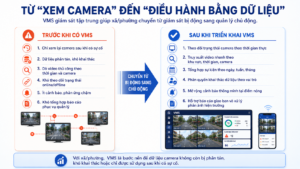
A centralized VMS helps wards and communes bring all cameras onto a shared management platform instead of operating them separately across multiple recorders or software systems. When integrated with AI cameras, the system not only supports live viewing, playback, and video extraction, but can also provide early alerts for situations such as illegal parking, sidewalk encroachment, improper waste disposal, abnormal gatherings, or intrusion into restricted areas.
This approach allows wards and communes to make better use of their existing camera infrastructure, reduce manual operations, and gradually shift from simply “watching cameras” to managing local areas with data.
For Ward and Commune Leaders
Leaders can monitor key information through a centralized surveillance screen combined with a visual dashboard showing the local situation. Data such as active alert areas, camera operating status, the number of events recorded, and hotspots requiring attention can be consolidated in one place, supporting faster direction and response coordination.
VMS data also supports internal briefings, evaluation of incident-handling results, and planning for camera expansion based on priority areas instead of relying on scattered information or manual reports.
For Camera System Management Teams
Operation teams can manage cameras, view live footage, review recorded video, check devices with signal loss, and extract video on a single platform. This helps shorten response time when incidents occur, especially as the number of cameras in the area continues to increase.
For Ward and Commune Police and Public Security Forces
The system supports ward and commune police and public security forces in monitoring key areas such as school gates, markets, streets, residential areas, and locations where public-order issues frequently arise. When an incident occurs, data is not only stored as standard video footage but can also be categorized by event, behavior, face, or vehicle information.
This allows authorities to quickly trace events by time, location, event type, subject characteristics, or related license plate. Such a storage and search mechanism helps reduce verification time, supports evidence-based incident handling, and minimizes reliance on manual camera review.
For Urban Order and Environmental Management Teams
AI cameras can help detect behaviors such as road and sidewalk encroachment, illegal parking, or improper waste disposal. Stored image data makes it easier to issue reminders, handle violations, and monitor recurring issues at each hotspot in a more transparent way.
For Officers Handling Citizen Feedback
When residents report issues related to public disorder, congestion, waste dumping, noise, or incidents in residential areas, officers can use the VMS to quickly check relevant camera data. This helps verify information more objectively and reduces coordination time between different departments.
For Local Residents
Residents benefit from a safer, more orderly, and more transparent living environment. When incidents occur in residential areas, schools, markets, or streets, centrally managed camera data enables ward and commune authorities to respond more quickly and with stronger supporting evidence.
Camera Data Security and Access Control Should Be Designed from the Start
When camera systems capture images of residents, vehicles, and public-area activities, data security must be considered from the design stage. Under Vietnam’s Decree No. 13/2023/ND-CP on personal data protection, biometric data is classified as sensitive personal data. Therefore, systems with facial recognition capabilities must be strictly controlled in terms of access rights and data storage.
A VMS platform for wards and communes should include:
- Role-based user access control
- Access and operation logs
- Clearly defined permissions for viewing, downloading, or exporting video
- Secure data storage mechanisms
This governance approach helps wards and communes make effective use of camera data while reducing risks during the storage, retrieval, and sharing of image-based information.
A Suitable VMS Deployment Roadmap for Wards and Communes
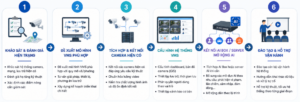
With a phased implementation approach, wards and communes do not need to replace their entire infrastructure from the beginning. They can first build a centralized surveillance platform, then expand into use cases such as traffic violation detection, sidewalk encroachment monitoring, improper waste disposal detection, intrusion alerts, or abnormal crowd detection.
A practical reference is the AI camera project deployed by ATIN for the Lao Cai Provincial Police. In this project, the system was applied to monitor people and vehicles, recognize license plates, identify faces, support rapid tracing, and aggregate data on a visual dashboard. This helped reduce dependence on manual monitoring and improve the effectiveness of local security management.
Conclusion
For wards and communes, cameras only deliver real value when data is centrally managed, quickly retrievable, and used for the right purposes. A centralized VMS helps standardize existing camera systems, monitor device status, control data access, and create a foundation for expanding AI camera modules based on specific hotspots. This supports local authorities in shifting from “watching cameras” to managing areas through data.
Each locality has different camera conditions, storage infrastructure, and surveillance needs.