
Artificial intelligence, machine learning, computer vision, and big data—once unfamiliar terms—are now becoming common language in digital transformation meetings across enterprises.
More than ever, technology is evolving from a supporting tool into a trusted business partner. It empowers people to unlock their full potential.
More than ever, operational processes are being digitized. Business decisions are no longer made purely on instinct. Instead, organizations rely on data, predictions, and pattern recognition to make smarter, faster, and more informed choices.
But to go further, businesses shouldn’t adopt technology blindly. True transformation begins with a deep understanding.
So, what exactly is machine learning? How does it work? And more importantly—where should businesses begin to leverage it effectively?
What is Machine Learning?
Machine learning is a crucial branch of artificial intelligence (AI) that enables computers to “learn” from data in order to make predictions and decisions—without being explicitly programmed for every specific task.
In the digital age, data is the new fuel. Machine learning helps businesses transform raw data into accurate and actionable insights. This empowers them to automate processes, optimize costs, and enhance customer experience.
Imagine you’re managing a retail chain.
Instead of relying on guesswork, a machine learning system can analyze customers’ purchase histories to identify shopping patterns and recommend the right products at the right time.
Beyond that, the system can also personalize promotions, suggest relevant product combos, and even send timely reminders that encourage customers to return and shop again.

How Does Machine Learning Work?
Machine learning operates based on algorithms that analyze data and extract patterns. Over time, these systems improve themselves without requiring manual reprogramming.
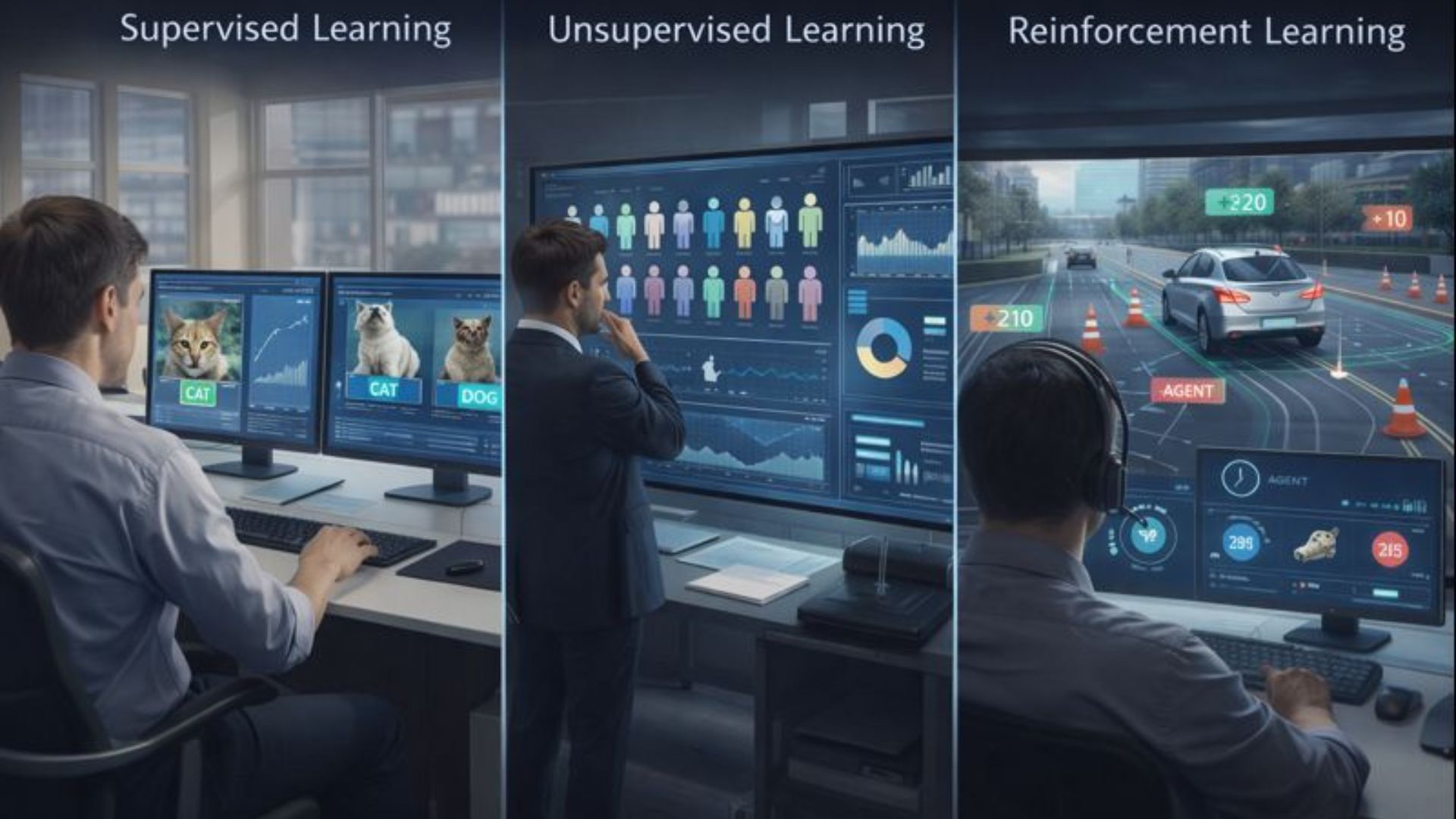
There are three main types of learning in machine learning:
-
Supervised learning
-
Unsupervised learning
-
Reinforcement learning
1. Supervised Learning
Imagine you’re training a new employee by giving them clear examples along with correct or incorrect feedback. Machine learning works the same way. The system is fed a dataset with labeled inputs and outputs (e.g., an image labeled “dog” or “cat”), and it learns to classify new data based on these examples.
In supervised learning, the model learns from existing input-output pairs. The goal is to discover an optimal mapping function that can accurately predict the output for new, unseen inputs.
Common algorithms include Linear Regression, Decision Trees, Support Vector Machines (SVM), and Neural Networks.
2. Unsupervised Learning
In this case, there are no labels or predefined answers. Think of it like observing customer behavior without prior knowledge—yet still being able to identify groups of people with similar habits. For example, a group of customers who often buy coffee in the morning may also frequently purchase bread. The system automatically groups them based on patterns.
Unsupervised learning works with unlabeled data and aims to uncover hidden structures or patterns. The model can cluster similar items or detect anomalies.
Popular algorithms include K-Means Clustering, Principal Component Analysis (PCA), Hierarchical Clustering, and Autoencoders.
3. Reinforcement Learning
Imagine you’re playing a game where every move results in a reward or penalty. After enough trial and error, you begin to learn which actions earn you more points.
Reinforcement learning allows machines to learn by interacting with their environment. Based on continuous feedback, the system gradually adjusts and improves its decision-making strategy.
This learning model is built around an “agent” that interacts with an environment. With every action, it receives a reward or penalty, helping it learn how to maximize total reward over time.
Each action leads to a new state in the environment, and from this sequence, the model learns an optimal policy.
Common reinforcement learning algorithms include Q-learning, Deep Q-Networks (DQN), and Policy Gradient Methods.
Benefits of Machine Learning for Businesses
Machine learning is not just a technology — it’s a strategic tool. It empowers businesses to operate smarter, faster, and more efficiently. Instead of relying on manual processes or gut feeling, businesses can now fully leverage the value of their existing data. As a result, they can:
Automate Processes
Repetitive tasks such as document classification, invoice checking, or handling simple requests can be automated almost entirely. This significantly saves time and resources.
Predict Demand and Trends
By analyzing past behaviors or market fluctuations, machine learning systems can predict consumer trends early, allowing businesses to plan more accurately and proactively.
Detect Fraud and Risks
Machine learning can identify anomalies and unusual patterns that are difficult for humans to detect. This enables businesses to prevent risks across operations, finance, or security.
Personalize Customer Experience
The system can automatically recommend products and tailor offers to specific customer segments. These adjustments happen in real time and are highly personalized.
Optimize Marketing and Sales
Behavioral analytics help determine the most effective channels and messaging. This leads to higher conversion rates and lower advertising costs.

How Is Machine Learning Applied in Vietnamese Businesses?
In Vietnam, many forward-thinking companies are actively adopting machine learning (ML) to optimize business operations—ranging from finance and human resources to manufacturing and agriculture. Below are some key sectors leveraging ML today:
1. Finance Sector
The finance industry in Vietnam is one of the leading adopters of machine learning to enhance efficiency and strengthen security across operations.
Practical Applications:
-
Predicting credit risk
-
Detecting fraudulent transactions
-
Optimizing investment portfolios
Real-World Example:
Techcombank integrates AI into its Techcombank Mobile app to personalize financial experiences. The system analyzes spending behavior and offers tailored alerts and financial advice. For instance, users who tend to spend more at the end of the month receive timely reminders and savings tips.
To date, the AI engine has generated over 52 million personalized recommendations for more than 4 million users. This approach not only helps customers manage finances better but also enhances their loyalty to the bank—creating real and sustainable business value.
(Source: Techcombank Keynote 2024)
2. Manufacturing Sector
In manufacturing, machine learning is driving higher productivity and improved product quality.
Applications:
-
Predictive maintenance
-
Supply chain management
-
Automated quality control
Real-World Example:
At Samsung’s production facilities in Vietnam, AI technologies are integrated into the development of smart consumer products like the Bespoke AI Laundry Combo™.
The washer uses AI Ecobubble™ to automatically adjust water levels and detergent based on load and soil level, saving energy and maximizing efficiency.
Other innovations, such as the WindFree™ air conditioners and Samsung Knox Matrix security system, demonstrate how Samsung applies AI not only in product development but also throughout production and testing—ensuring quality, safety, and an outstanding user experience.
(Source: chinhphu.vn)
3. E-commerce Sector
Beyond internal operations, machine learning is transforming how companies engage and retain consumers, especially in the e-commerce space.
Applications:
-
Personalized product recommendations
-
Customer sentiment analysis
-
Demand forecasting
Real-World Example:
E-commerce platforms like Lazada Vietnam are leveraging ML to personalize the user experience—from intelligent product suggestions to customized interface layouts based on browsing and purchase history.
This has led to higher conversion rates and improved customer retention.
(Source: vneconomy.vn)
4. Agriculture Sector
In a field often considered less technological, machine learning is proving highly valuable—turning data like weather conditions, soil health, and crop growth into tools for optimizing harvests.
Applications:
-
Pest and weather forecasting
-
Precision farming
-
Agricultural supply chain optimization
Real-World Example:
Smart farming models in Vietnam are implementing AI-powered monitoring systems to track soil moisture, temperature, and nutrient levels.
This data is continuously analyzed to help farmers adjust irrigation and fertilization schedules and predict potential disease outbreaks early.
(Source: dantri.com.vn)
5. Human Resources (HR) Sector
Aside from operations and production, machine learning also plays a critical role in managing human capital—a core asset for any modern business.
Applications:
-
Intelligent recruitment
-
Employee attrition analysis
-
Training optimization
Real-World Example:
Vietjet has incorporated AI into its recruitment process using automated interview systems that ask questions tailored to each applicant’s profile.
The AI also evaluates teamwork skills, foreign language abilities, and scenario-based responses.
Additionally, it can assess appearance and demeanor to match cabin crew standards.
Thanks to AI, the recruitment process is faster, more transparent, and paperless—enhancing candidate comfort while saving time and cost for the company.
This approach reflects not just modernity and efficiency, but also a human-centered mindset.
(Source: thanhnien.vn)
How Can Businesses Get Started with Machine Learning?
Implementing machine learning doesn’t have to begin with a large-scale project. What matters most is starting with the right strategy and a clear vision.
1. Define a Clear Business Problem
Don’t start with the technology—start with the question:
“What specific problem are we trying to solve?”
It could be forecasting demand, detecting fraudulent transactions, or reducing employee turnover. Machine learning is only effective when it is aligned with concrete business objectives.
2. Build a Reliable Data Foundation
Machine learning models perform best when they are trained on clean, complete, and well-formatted datasets.
Scattered or inconsistent data can lead to misleading results and poor decision-making.
Invest in organizing and “cleaning” your data to ensure accuracy and trustworthiness.
3. Choose the Right Team or Technology Partner
You can either build an in-house ML team or collaborate with a third-party partner with hands-on implementation experience.
The key is to work with professionals who not only understand the technical side, but also grasp your specific business challenges and industry context.
4. Start Small, Then Scale
Instead of deploying machine learning across your entire organization, begin with a pilot project—for example, analyzing customer segments or automating a single process.
Learn from real-world results, then refine and expand the scope step by step.
Need a Starting Point?
If you’re unsure where to begin, don’t hesitate to reach out to ATIN.
Our team of experts is ready to help you:
-
Define the right business goals
-
Assess and structure your data
-
Recommend a clear, phased roadmap to success
Let us help you turn machine learning into measurable business value—starting from where you are, and moving forward with confidence.
Turning Machine Learning into Real Business Value
Machine learning is no longer a concept reserved for tech companies. More and more businesses in Vietnam are now applying it to real-world operations.
From demand forecasting to personalized customer experiences, machine learning is transforming how businesses operate. Beyond that, many companies are using it to automatically detect errors and reduce operational mistakes.
When implemented correctly, machine learning becomes a powerful driver for sustainable growth.
At the end of the day, it’s not about what technology you have—it’s about whether you’re solving the right business problems.
You’ve seen the opportunity. Now is the time to act.
And if you’re ready to explore how machine learning can deliver real value to your business, we’re here to help.